jump to content
Quotation Cart: 0 articles

News for Leica HCS A

Webinar on Confocal Microscopy Sep 6, 2011

02 September 2011

Zebrafish, Danio rerio. Image taken with Leica HCS A

Plodia interpunctella. Image acquired using CARS technique.

FLIM image. Image acquired with Leica TCS SP5 X.

Research at the Frontiers of Confocal Microscopy

Dear Scientist,

Are you interested in learning about Frontiers in Confocal Microscopy - Upscaling, Chemical Imaging & Supercontinuum FLIM?

Register today for the free webinar on September 6, 2011 at 15:00h (14:00h UK) to learn more from experts in Confocal Microscopy!

Speakers:

  • Dr. Corentin Spriet
    Institut de Recherche Interdisciplinaire - IRI, CNRS - Université de Lille, France
  • Dr. Eric Olaf Potma
    Beckman Laser Institute and Medical Clinic School of Medicine, University of California, Irvine
  • Dr. Jürgen Reymann
    ViroQuant-CellNetworks RNAi Screening Facility, University of Heidelberg and BioQuant, Heidelberg, Germany

Coherent Anti-Stokes Raman Spectroscopy - Leica TCS CARS

Fluorescence Lifetime Imaging - Leica TCS SMD FLIM

High Content Screening Automation - Leica HCS A

Join the Leica Webinar on Confocal Microscopy (CARS, FLIM, HCS)

  • Date: Sept. 6th, 2011
  • Time: 15:00 h (14:00 h UK)
  • Length: Aprox. 1 hour

Click here to join the Confocal Webinar

Leica Microsystems and Definiens Announce Co-Marketing in the Area of Drug Discovery Research

13 April 2011

Flexibility – for imaging and analysis without limits

Collaboration will Complete Confocal Data Acquisition with Advanced Analysis in High-Content Screening

Wetzlar / Munich, Germany. Leica Microsystems, a leading global designer and producer of precision optical systems, and Definiens, the leading Health Image Intelligence™ company, today announced a co-marketing agreement. Under the terms of the agreement, Definiens and Leica will cooperatively market their complementary products and host joint workshops and educational events. Customers will benefit from streamlined high-content image analysis, allowing them to better identify and understand pathways and mechanisms.

Flexibility – for imaging and analysis without limits

This partnership will cover a range of Leica microscopy hardware and Definiens XD software, which will be seamlessly integrated to optimize imaging and analysis workflows.

Leica Microsystems’ confocal instrumentation produces the data bases necessary to turn images into knowledge. Precision and sensitivity pair up uniquely at highest resolution of up to 64 megapixels, producing a wealth of information. The company recently released its first High Content Screening Automation package for confocal research microscopes, Leica HCS A, a highly flexible tool for automated imaging in multiple dimensions. The package enables fast and efficient multi-position experiments – from automated image recording routines to complex multi-dimensional high-content screening experiments with simultaneous image export for immediate analysis by external analysis software, such as Definiens Developer XD.

Definiens Developer XD is an integrated software development environment designed for the entire range of biomedical image analysis problems. It works with any imaging modality as well as 2D, 3D and time-lapse applications and reliably analyzes the wealth of data generated by Leica’s confocal microscopes. Definiens Developer XD enables the automated analysis of cases that previously required tedious manual segmentation.

“Definiens and Leica Microsystems share a commitment to developing powerful imaging solutions that help researchers understand biological pathways faster and more accurately,” said Thomas P. Heydler, CEO of Definiens. “This partnership will provide Leica customers with access to Definiens’ advanced image analysis software, enabling high-content screening that directly aids drug discovery efforts around the world.”

Any device format is supported – any amount of data can be processed

With the combination of Leica Microsystems TCS SP5 confocal imaging instrumentation, single and multiple projects are easy to handle – from single images that need to be evaluated at high standardization to 3D image stacks and 4D time series. Even smallest series of throughput are possible in manual process steps. The results are exported and analyzed by Definiens Developer XD within a highly automated workflow to fulfill today’s demand for throughput in advanced life science research.

“Together with Definiens, we look forward to the opportunity to make highly developed and future-proof high content screening solutions widely available for academic research as well. The combination of high-sensitivity confocal technology, miniaturized sample handling and reproducible evaluation with optimized data management is a sine qua non among drug discovery strategies and the analysis of their physiological relevance,” says Dr. Stefan Traeger, Managing Director of the Life Science Division of Leica Microsystems.

From single files to terabytes of data – Leica Microsystems and Definiens offer a fast, reliable and adaptive high-throughput solution to modern life science research creating a new approach to multidimensional image analysis in high content screening.

Please find more information about this topic during the ‘Focus on Microscopy’ conference in Constance, Germany, from April 17 – 20 at the booths of Leica (25) and Definiens (24).

_ _ _ _ _ _ _ _ _ _ _ _ _ _ _

Leica Microsystems is a world leader in microscopes and scientific instruments. Founded as a family business in the nineteenth century, the company’s history was marked by unparalleled innovation on its way to becoming a global enterprise.

Its historically close cooperation with the scientific community is the key to Leica Microsystems’ tradition of innovation, which draws on users’ ideas and creates solutions tailored to their requirements. At the global level, Leica Microsystems is organized in four divisions, all of which are among the leaders in their respective fields: the Life Science Division, Industry Division, Biosystems Division and Medical Division.

Leica Microsystems’ Biosystems Division, also known as Leica Biosystems, offers histopathology laboratories the most extensive product range with appropriate products for each work step in histology and for a high level of productivity in the working processes of the entire laboratory.

The company is represented in over 100 countries with 12 manufacturing facilities in 7 countries, sales and service organizations in 19 countries and an international network of dealers. The company is headquartered in Wetzlar, Germany.

_ _ _ _ _ _ _ _ _ _ _ _ _ _ _

Definiens is a leading Health Image Intelligence™ company that develops software solutions for biomedical image analysis, data mining and clinical decision support. The company’s software analyzes images from cell-based assays, whole tissue slides and full body scans and allows users to correlate this information with data derived from other sources, supporting better decisions in research, diagnostics and therapy. By automating analysis workflows and generating new knowledge, Definiens provides pharmaceutical and biotechnology companies, research institutions, clinical service organizations and medical professionals with deeper insights, faster results and better decision support. Harnessing the power of image intelligence, Definiens supports personalized medicine and aims to significantly improve the quality of patients’ lives.

Definiens is headquartered in Munich, Germany, and has offices throughout the United States. Further information is available at www.definiens.com.

Definiens – from images to clinical decisions.

Leica HCS A – the Platform for Primary and Secondary Screening

18 October 2010

Leica HCS A: the flexible solution for primary and secondary screens on confocal and widefield systems.

High-Content Screening Automation for Confocal and Widefield Microscopy

Wetzlar, Germany. Leica Microsystems has extended its automated high-content screening solution to cover applications on widefield fluorescence systems. The Leica HCS A package enables fast and efficient multi-position experiments – from automated image recording routines to complex multi-dimensional high-content screening experiments with simultaneous image export for immediate analysis by external analysis software.

Intelligent automation

Thanks to the specially developed CAM (Computer Aided Microscopy) interface, the screening experiment can be remote controlled from other software packages. Intelligent algorithms can analyze images on the fly and send the new target coordinates and recording parameters via the CAM interface to the screening system, depending on the result of the analysis. The Leica widefield or confocal system switches immediately from the primary scan to a predefined high-resolution secondary scan. The CAM interface therefore makes the Leica HCS A system a highly efficient and extremely flexible tool for a number of applications including rare event detection.

Flexibility – for imaging without limits

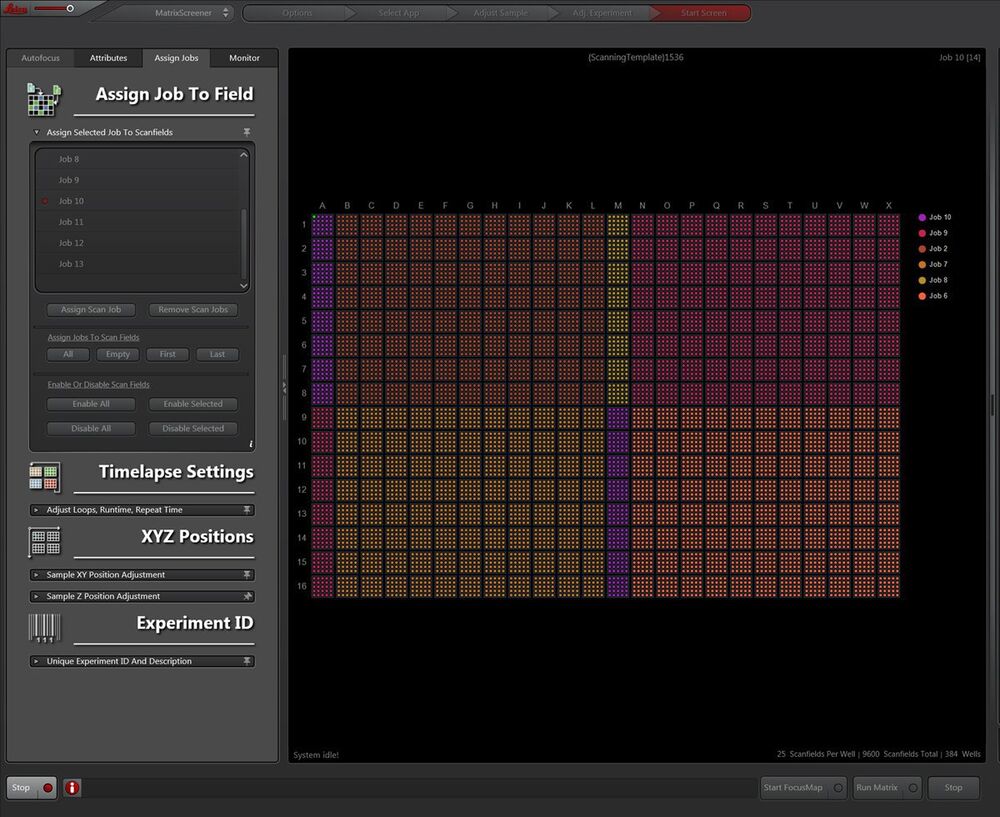
Based on the LAS AF Matrix M3 software, the Leica HCS A package also offers top-level flexibility for defining screening patterns. It can be used for microtiter plates, chambered coverslips, spotted arrays, tissue micro arrays, petri dishes and lab-on-a-chip applications. The single positions can be combined with different recording parameters. The complete parameter settings can also be transferred by LAN for use by all other HCS A screening systems. The software platform offers a number of modules and functions that greatly enhance the efficiency of the imaging system. The starter packages contain simple processes such as automatic composition of separate images (mosaicing) or multi-well plate screening in 2D or 3D. More sophisticated requirements are served by software-supported autofoci for drift compensation for each individual position, single-object tracking using a motorized stage to follow the sample or automated immersion medium feed for water objectives to take just a few examples.

The perfect match

High-content screening experiments usually generate several thousands of single images that have to be saved and analyzed. The Leica HCS A image formats are compatible with the Open Microscopy Environment format and therefore totally platform-independent.

The Leica HCS A was designed for the main confocal and widefield system platforms of Leica Microsystems. Users can choose between the Leica TCS SP5 broadband confocal system, the Leica TCS LSI for the visualization of samples from micro to macro scale or the Leica TCS SPE, which is known for its stability and ease of use, the Leica AF7000 and Leica AF6500 high-speed systems for widefield fluorescence and the flexible widefield system Leica AF6000.

Leica Microsystems is a leading global designer and producer of innovative, high-tech, precision optical systems for the analysis of microstructures. It is one of the market leaders in each of its business areas: Microscopy, Confocal Laser Scanning Microscopy with corresponding Imaging Systems, Specimen Preparation, and Medical Equipment. The company manufactures a broad range of products for numerous applications requiring microscopic imaging, measurement, and analysis. It also offers system solutions for life science including biotechnology and medicine, research and development of raw materials, and industrial quality assurance. The company is represented in over 100 countries with 13 manufacturing facilities in 8 countries, sales and service organizations in 19 countries and an international network of dealers. The international management is headquartered in Wetzlar, Germany.

New Tool to Amplify the Power of Confocal Imaging

25 March 2010

Leica HCS A: the right tool to automate research work easily and efficiently.

Leica HCS A – High Content Screening Automation

Mannheim, Germany. High content screening is a growing discipline in life science research as the number of complex experiments is increasing and statistically relevant data become a “must” for scientific publications.

Leica Microsystems has released the first High Content Screening Automation package for confocal research microscopes Leica HCS A. Combining the strength of high-resolution point scanners with the new ingenious LAS AF MATRIX M3 software platform delivers a highly flexible tool for automated imaging in multi dimensions. As the value is more than the sum of its parts, Leica Microsystems enables researchers to customize Leica confocal microscopes according to actual requirements in life science research laboratories.

Basic automation like mosaicing of tissue slides or multiwell plate screening in 2D and 3D are part of the starting packages. More sophisticated demands are satisfied by intelligent microscopy: five new auto foci, single object tracking or automated control of water objectives always deliver excellent results.

As important as to generate thousands of images it is important to consider their storage and analysis. Therefore, the new export formats are compatible to Open Microscopy Environment by OME.TIFF. Standard TIFF-files can be read by any modern image analysis software, too.

Customize your confocal”, that is the idea Leica Microsystems shared with leading researchers and lead them to create the Computer Aided Microscopy (CAM) interface. By remote control of the imaging process, the detection of rare events like e.g. mitosis phases now becomes reality. Sophisticated algorithms can analyze images on-the-fly and report the target coordinates to the instrument via the programming interface CAM. Immediately, the pre-scan switches to high-resolution zoom-in mode and starts to image the target cells directly, offering excellent perspectives for a new type of experiments.

Leica HCS A is designed for the core confocal platform systems. Users can choose between the Leica TCS SP5 broadband confocal, the Leica TCS LSI to visualize specimen from micro to macro scale, or the Leica TCS SPE, known for ease of use and robustness. Leica Microsystems offers the right tools to automate research work easily and efficiently.

Leica HCS A for Automated High Content Screening

19 February 2010

From Fast Multiwell Plate Screening to High Content Information

From Research Question to Research Result

Amplify the Power of Imaging

Benefit from more than a powerful imaging tool when you make the Leica TCS SP5, Leica TCS LSI or Leica TCS SPE your high content screening system!

High resolution, fast scanning, and intelligent automation provide more content as the basis for superior statistical analysis.

The combination of Leica HCS A with sophisticated image analysis using the Open Microscopy Environment (OME) for real time data exchange results in comprehensive insight and amplifies the scope of your life science research!

High Content Screening (HCS) is the answer to the change from descriptive to quantitative fluorescence imaging in Life Science research.

More and more statistically relevant data are required and the experiments are becoming more complex.

High resolution imaging automation answers complex questions in shorter time: Cell biology, Genetics, Drug discovery & testing, Systems biology.

High Content Screening automation discloses interrelationships in cells and
organisms efficiently. Leica Microsystems offers a set of innovative tools to
complement your high-resolution microscope into a high content imaging device.


ImprintLegal NoticeContact Webmaster

Deutsch日本語한국어