
Overview
The Leica Application Suite Image Overlay module combines Leica’s strengths in automated fluorescence microscopy, digital camera technology and advanced imaging. Constructed for the visualisation, enhancement and digital documentation of coloured fluorescence microscope images, it is extremely versatile, making it suitable for users in bioscience, medical and pharmacological laboratories. It is designed for multi-channel imaging and performs tasks in a simple, automatic manner.
Key Features
-
Experiments benefiting from LAS Image Overlay include those concerned with immunofluorescence, Green Fluorescence Protein (GFP), Multi-wavelength image data, Quantitative fluorescence and Co-localisation of multiple fluorophores. The rich selection of unique benefits include:
-
A workflow orientated User Interface with simple interactive means of defining imaging conditions for each channel.
-
Total microscope and digital camera control in a fully integrated manner.
-
Automatic acquisition of channel images by computer selection of contrast method, filter and exposure.
-
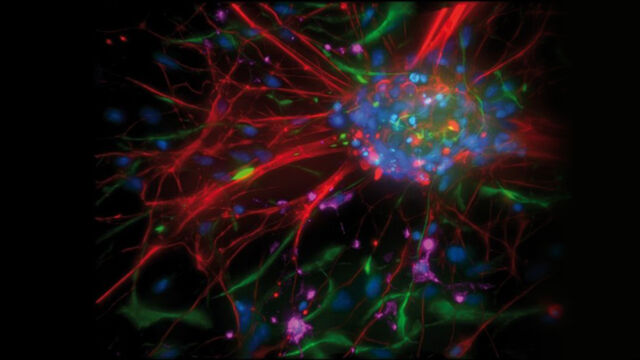
Channel images which can be combined into a colour Overlay image for simultaneous visualisation.
Precise control of microscope functions is essential for high quality fluorescence imaging. By displaying a live image with exposure adapted to the selected filter, it is easy to compose the image in the field of view. The camera’s sensitivity, which is further improved by binning modes, makes it suitable even when light levels are very low.
A gallery is provided where associated images are attached to the main view so that channel images can be displayed immediately.
Furthermore, the Image Overlay module enables images to be enhanced by applying a range of image processing techniques. This includes image contrast, brightness and gamma which can be adjusted to optimise the image display.
Other benefits of the Leica Application Suite Image Overlay Module include:
Fully integrated fluorescence microscope control for Leica MZ16FA stereomicroscope, Leica DM and DMI upright and inverted microscopes including the ability to change filters and shutters easily without manual operation.
The ability to select a small region of interest from the whole image to identify an area of significance and view it in detail.
Cameras can provide 8-bit or 16-bit images, in monochrome or RGB retaining the full dynamic range of the high bit-depth.
Images can be annotated with calibration markers for an obvious guide to size of microstructure.