
The Fast Track to Superresolution Leica TCS STED CW

The new Leica TCS STED CW is the most uncomplex way to nanoscopy for research. The system resolves structures smaller than 80 nm – with purely optical methods.
The depletion lasers and emission lasers in the visible spectral range enable researchers to use conventional dyes such as Alexa 488, FITC and Oregon Green and beyond that established fluorescence proteins such as YFP.
Dynamics of sub-cellular processes can be imaged due to this flexibility and the system's ability of fast data acquisition. This means: live cell imaging below the diffraction limit!
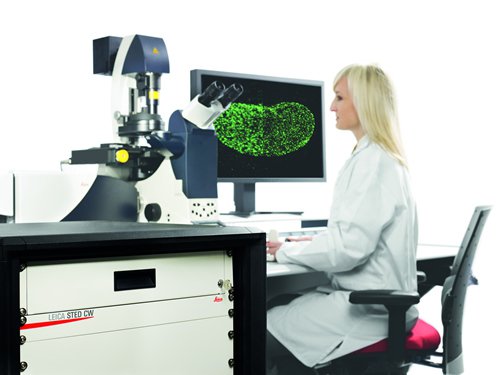
Your Advantages
![]() |
![]() |
Freedom to Choose - Popular Fluroescent Dyes and ProteinsSTED microscopy in the visible range enables to use labels like Alexa 488 and Oregon – plus genetically encoded standard markers like YFP for imaging on the nanoscale. Watch live cell experiments at the nanoscale! |
Observe What's Inside - with Confocal SuperresolutionThe superior optical sectioning of the true point scanning system Leica TCS SP5 provides superresolution deep inside the sample. Acquire STED-images inside a 12 µm thick drosophila larvae featuring a thick cuticula. Record complete 3D stacks. |
Nanoscale Imaging - Devoid of Mathematical ArtefactsProfit from superresolution pixel by pixel independent of recording speed or dye. STED is a purely optical superresolution concept. The extreme robustness against interframe-drifts protects your data and makes data handling easy and safe. |
Quick and Affordable Upgrade to STEDThe modular STED concept allows installed Leica TCS SP5 systems to be upgraded on-site and in a short time. The STED upgrade can be tailored to your needs. |
![]() |
![]() |
Direct contact, consulting and support
- Find your local Leica Microsystems partner
- Get quotes for buying, leasing and renting - profit from owning a Leica Microsystems product
- Tailored advice - learn about the benefits Leica Microsystems provides for your work situation


