jump to content
us

News for Leica TCS SP5 MP

Leica TCS SP5 MP with Fully Integrated OPO Extends Application Range of Multiphoton Microscopy

16 December 2010

Tubulin. Multiphoton excitation of Atto 647N at 1200nm.

A powerful tool for in vivo imaging.

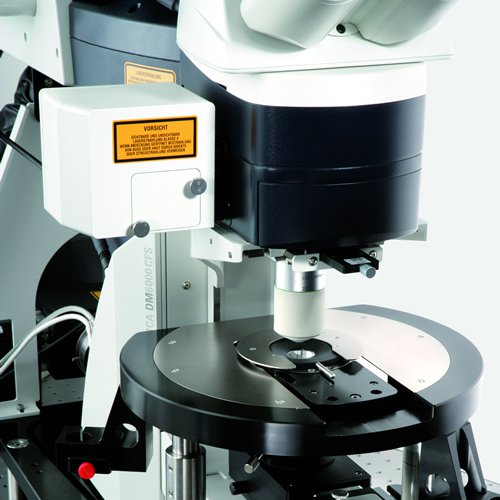
Mannheim, Germany. Leica Microsystems has effectively matched the Leica TCS SP5 MP multiphoton microscope with a fully integrated OPO (Optical Parametric Oscillator) solution. The integration of the Coherent Chameleon Compact OPO with the Leica TCS SP5 MP confocal and multiphoton microscope allows observation of fast dynamic processes in living cells with deep penetration at high resolution with one integrated microscope system.

Full integration of the OPO within the software control of the multiphoton sys­tem greatly facilitates research as it en­ables the user to precisely adjust the excitation sources as well as all other imaging settings within the same soft­ware. This makes the Leica TCS SP5 MP with OPO a powerful tool for in vivo imaging.

The Leica TCS SP5 MP with OPO ex­tends the choice of excitation wave­lengths from formerly up to 1080 nm to now up to 1300 nm. The user can con­veniently select between OPO and stan­dard MP excitation wavelengths and has the choice of simultaneous or sequential excitation with the OPO and MP laser together.

The broad range of excitation wavelengths allows for multiphoton excitation of dyes and cellular auto fluorescence from the visible up to the red range of the spectrum. This allows the researcher to use red dyes such as mCherry, DsRed2, mRFP, TexasRed and Alexa660 for multiphoton microscopy. Using dyes at longer excitation wavelengths is less harmful to the specimen and decreases the amount of scattered light. This allows deeper penetration into very thick samples like thick tissue sections and whole mount preparations of complete organs.

The addition of the Leica OPO solution to the Leica TCS family greatly extends the range of multiphoton applications with respect to multiphoton excitation in NIR and IR, viability of the samples as well as pene­tration depth. The fully integrated Leica OPO solution represents a further milestone of innovative devel­opments by Leica Microsystems.

_ _ _ _ _ _ _ _ _ _ _ _ _ _ _

Leica Microsystems is a leading global designer and producer of innovative, high-tech, precision optical systems for the analysis of microstructures. It is one of the market leaders in each of its business areas: Microscopy, Confocal Laser Scanning Microscopy with corresponding Imaging Systems, Specimen Preparation, and Medical Equipment. The company manufactures a broad range of products for numerous applications requiring microscopic imaging, measurement, and analysis. It also offers system solutions for life science including biotechnology and medicine, research and development of raw materials, and industrial quality assurance. The company is represented in over 100 countries with 13 manufacturing facilities in 8 countries, sales and service organizations in 19 countries and an international network of dealers. The global management is headquartered in Wetzlar, Germany.

New Leica DMI6000 B with Adaptive Focus Control (AFC)

30 September 2010

The new Leica DMI6000 B with Adaptive Focus Control (AFC) for researchers who demand consistent multidimensional imaging without loss of focus.

Leica Adaptive Focus Control is based on the reflection of a LED light beam at an appropriate surface such as the bottom of a Petri dish or multi well plate. The light is projected through the objective to the surface and reflected onto a light-sensitive sensor. The position of the light spot on the sensor is defined by the position of the specimen in relation to the objective. Due to temperature drift, this distance changes and the light spot on the sensor is shifted in relation to the original position. A feedback mechanism records this shift in the light spot position and corrects the z-focus position accordingly.

Explore Life in All Dimensions

Wetzlar, Germany. Imaging dynamic processes in living cells is challenging, even for the most precise and reliable microscopy systems. The Leica DMI6000 B inverted microscope stand is at the heart of our widefield or confocal systems for live cell imaging, offering unsurpassed stability inherent to its design. But even the most robust microscope will be susceptible to sudden changes in temperature, for instance when a climate chamber is opened during an experiment to apply a drug to the specimen. This can result in out-of focus images during time-lapse recordings. Leica Microsystems has now developed a Leica DMI6000 B with Adaptive Focus Control (AFC) for researchers who demand consistent multidimensional imaging.

The fully automated AFC is based on the reflection of a light beam at a suitable surface (e.g. petri dish) to keep the distance between the objective and the specimen constant. Available for both widefield (including TIRF) and confocal applications, AFC dynamically regulates the focus position, whenever or wherever the experiment requires it. For more flexibility, AFC can also be operated in stand-alone mode and requires neither a PC connection nor additional external control devices.

The underlying technique works for all selected contrasting methods and does not involve the acquisition of images. This ensures that cells remain viable for longer, delivering reliable results even over extended periods of time. The intelligent automation of the system provides the ultimate in ease of use, automatically optimizing all settings for each objective. With the option to effectively combine AFC with a high-speed digital auto focus, cells which change their morphology and shape during the course of the experiment are now easy to follow, while minimizing exposure to light.

The new Leica Adaptive Focus Control is available for Leica DMI6000 B, Leica AM TIRF MC, Leica TCS SP5 II, Leica TCS SP5 II DS, and Leica TCS SP5 MP.

Leica Microsystems is a leading global designer and producer of innovative, high-tech, precision optical systems for the analysis of microstructures. It is one of the market leaders in each of its business areas: Microscopy, Confocal Laser Scanning Microscopy with corresponding Imaging Systems, Specimen Preparation, and Medical Equipment. The company manufactures a broad range of products for numerous applications requiring microscopic imaging, measurement, and analysis. It also offers system solutions for life science including biotechnology and medicine, research and development of raw materials, and industrial quality assurance. The company is represented in over 100 countries with 13 manufacturing facilities in 8 countries, sales and service organizations in 19 countries and an international network of dealers. The international management is headquartered in Wetzlar, Germany.

Online Seminar/Webinar on Multiphoton Excitation and Deep Imaging Applications

21 September 2010

Dorsal musculature of zebrafish

Adult rat cardiomyocytes

Tubulin filaments, Atto 647N, excitation at 1200 nm

In 2-photon excitation fluorescence emission occurs only on the focal plane

The Solution for Deep Imaging – Leica Multiphoton Confocal System

Tuesday, 19th October 2010 at 5pm (CET), 4pm (UK), 11am (EDT)

Register for Online Seminar/Webinar on Multiphoton Excitation and Deep Imaging Applications

http://www.microscopy-analysis.com/leicawebinars

Multiphoton microscopy is the method of choice for non-invasive deep-penetration fluorescence microscopy of thick highly scattering samples.

Multiphoton microscopy is optimal for a diversity of fixed and living biological samples. Specimens can range from thick organ sections, intact organs and whole embryos to entire animals.

Advantages of multiphoton excitation are:

  • Greater penetration depth due to low scattering
  • Reduced phototoxicity due to spatial confinement leads to longer lifetime of living cells
  • Bleaching restricted to focal plane – no volume bleaching
  • Intrinsical optical sectioning properties – no need for a detection pinhole

Join our webinar to hear about Deep Imaging Applications with the Leica multiphoton confocal system Leica TCS SP5 MP.

Learn more about Leica’s new, full-integrated Chameleon Compact OPO solution. The OPO (optical parametric oscillator) offers you multiphoton excitation up to 1300 nm and therefore even less scattering and deeper tissue penetration

Register for the Webinar here!

http://www.microscopy-analysis.com/leicawebinars


ImprintLegal NoticeContact Webmaster

Deutsch日本語한국어中文