


A facility that runs on reliability
The VIB BioImaging Core is part of the Flanders Institute for Biotechnology (VIB), a leading European research network. The Ghent facility supports dozens of research groups, offering access to high-end imaging systems and technical expertise across a wide range of disciplines.
“We have many microscopes from different companies — Leica, Nikon, and others — and a large variety of users,” explains Jérémy Verbeke, Light Microscopist at the VIB BioImaging Core. “Reliable availability is essential, because downtime can really disrupt research.”
From plant development to immunology and inflammation studies, the core hosts diverse experiments that depend on continuous imaging performance. “We see everything from tissues and organoids to plant roots and bacterial samples,” Jérémy says. “Our instruments are in constant use — and every hour of uptime counts.”

Challenge: Detecting the invisible
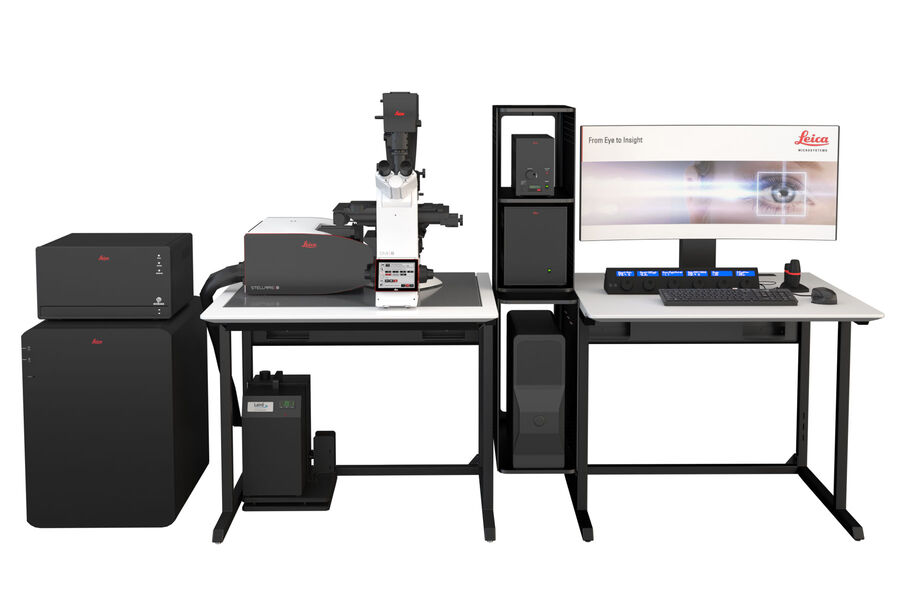
In July 2025, Leica Microsystems’ RemoteCare monitoring platform flagged a potential issue: the Stellaris 8 microscope’s chiller coolant level had dropped to a critical low. Although the microscope was still maintaining its temperature perfectly at 18 °C, the coolant shortage could have caused overheating and unexpected downtime if left unchecked.
Why was this “invisible” — even though the system has local warnings?
The question naturally arises: If the coolant level is critical for operation, why was it not detected on-site? The answer lies in how facilities operate and where indicators are located:
- The Stellaris 8 uses an external chiller, located separately from the microscope.
- It has its own digital temperature display and a flashing LED that signals low coolant.
- The LAS X software also provides several levels of warnings:
- Non-critical temperature alerts (yellow info bar) for sensors such as the Mainboard, X-Galvo, HyD S, and supply unit
- Critical temperature alerts (red blocking dialog) for FPGA board temperature
- All events are logged in the LCS Error Log and the local RemoteCare log.
However, in a multi-user facility:
- The chiller is physically less visible in the room.
- Non-blocking warnings are easy to overlook during busy operation.
- Critical warnings require the user to press “OK” — meaning a user may dismiss or miss the prompt.
- Over weekends or during long experiments, critical thresholds may be reached without someone present to follow up.
As Jérémy notes:
“I didn’t know the system could detect something like the chiller coolant level. The chiller is quite hidden in the room, so we wouldn’t normally notice it during routine checks.”
Is overheating truly dangerous?
Yes. If temperature rises due to insufficient cooling, effects can include:
- slower system performance
- increased image noise from reduced detector sensitivity
- overheating of galvos leading to malfunction
- and in extreme cases, electrical or mechanical damage
This is exactly why early detection is so valuable. RemoteCare’s continuous monitoring ensures that even if on-site warnings are overlooked, someone reacts on time.
Solution: Predictive service in action
Leica’s RemoteCare specialists acted right away. They confirmed the issue, provided clear guidance on the required coolant, and arranged immediate delivery.
Within a few days, the coolant arrived on site — allowing the team to refill the system and keep a reserve bottle for future use.
“Communication was really smooth,” Jérémy recalls. “We discussed how to solve the issue and what type of coolant was needed. Everything was handled quickly, and the Stellaris 8 never stopped running.”
Thanks to this fast, predictive response, the potential downtime was completely avoided.
“The predictive service is very valuable,” Jérémy says. “Users don’t always notice technical problems, so automatic alerts help us react quickly. It saves time, prevents bigger issues, and gives us real peace of mind.”
A partnership built on trust
The collaboration between VIB and Leica goes far beyond maintenance. It’s a partnership based on responsiveness, open communication, and shared commitment to innovation.
“We have a great relationship with the Leica team in Belgium,” says Jérémy. “It’s not just a vendor relationship — it’s a real collaboration. We can always reach out to the specialists, and they respond quickly. Everything is handled efficiently and professionally.”
He adds that predictive technologies fit perfectly with the facility’s forward-looking approach.
“We’re always open to new tools — including AI — that help detect potential problems before they happen. Anything that helps us maintain uptime and efficiency is a big advantage.”
By leveraging RemoteCare, we can enable proactive support, scalable service models, and data-driven decision-making — transforming how Service is delivered. This helps our customers maximize uptime, reduce operational costs, and gain actionable insights from Leica instruments.
Mark Zarycki, Product Manager – Digital Services
Your benefits
Behind the scenes: Predictive service technology
- Leica Microsystems’ microscopes are born-connected. The majority of new microscopes now ship RemoteCare-ready. When enabled, RemoteCare works continuously to improve your system’s uptime and total cost of ownership.
- RemoteCare continuously monitors system parameters such as temperature, coolant levels, and condition of wearable parts. Customizable monitoring algorithms track parameters in real time and over defined periods.
- When early warning signs appear, Leica’s global service experts step in immediately — providing remote diagnostics, expert guidance, and rapid logistics support. Should a breakdown occur, connected microscopes experience 40% shorter downtime versus unconnected systems.
- With proactive monitoring and fast response, potential issues are resolved before they ever affect performance. Combined with Leica’s large service footprint, customers and their experiments benefit from legendary reliability.
Benefits
- 40% shorter downtime for connected instruments
- Real-time notifications of many instrument issues, including overheating
- Ability to upload instrument log files for detailed analysis