How fluorescence microscopy is useful for industrial applications
Many industrial inspections rely on brightfield, darkfield, or polarization contrast. These techniques show shape and structure, but they often miss information about material composition. Fluorescence microscopy adds an additional layer of analysis. When certain materials or dyes are excited with light of shorter wavelength, for example, ultraviolet (UV), they then emit light with a longer wavelength, for example, visible light. This fluorescence emission reveals information about features which cannot be seen with standard illumination alone. In this webinar, it is demonstrated how this effect can uncover hidden defects, coatings, fibers, and material differences on actual industrial samples.
Isn’t fluorescence only used for biological applications?
That’s a common question, but also a common misconception. Fluorescence is often used in the field of biology, but, as shown in this webinar, industrial and material samples can also benefit from fluorescence microscopy. Examples include analysis of security fibers in banknotes and passports, protective coatings on electronic circuit boards, and dyed materials used in manufacturing. These examples prove that fluorescence microscopy is not just about getting colorful images, it’s about making what may be invisible with conventional microscopy actually visible for QC, inspection, and R&D.
Industrial applications where fluorescence microscopy is valuable
Electronics and PCB inspection
The webinar shows how fluorescent dyes added to protective coatings on PCBs allow you to check layer coverage and detect areas where it is thin or missing. Thin or uneven coatings appear darker in fluorescence images, something that remains hidden when imaging with conventional white light contrast.
Textiles, polymers, and fibers
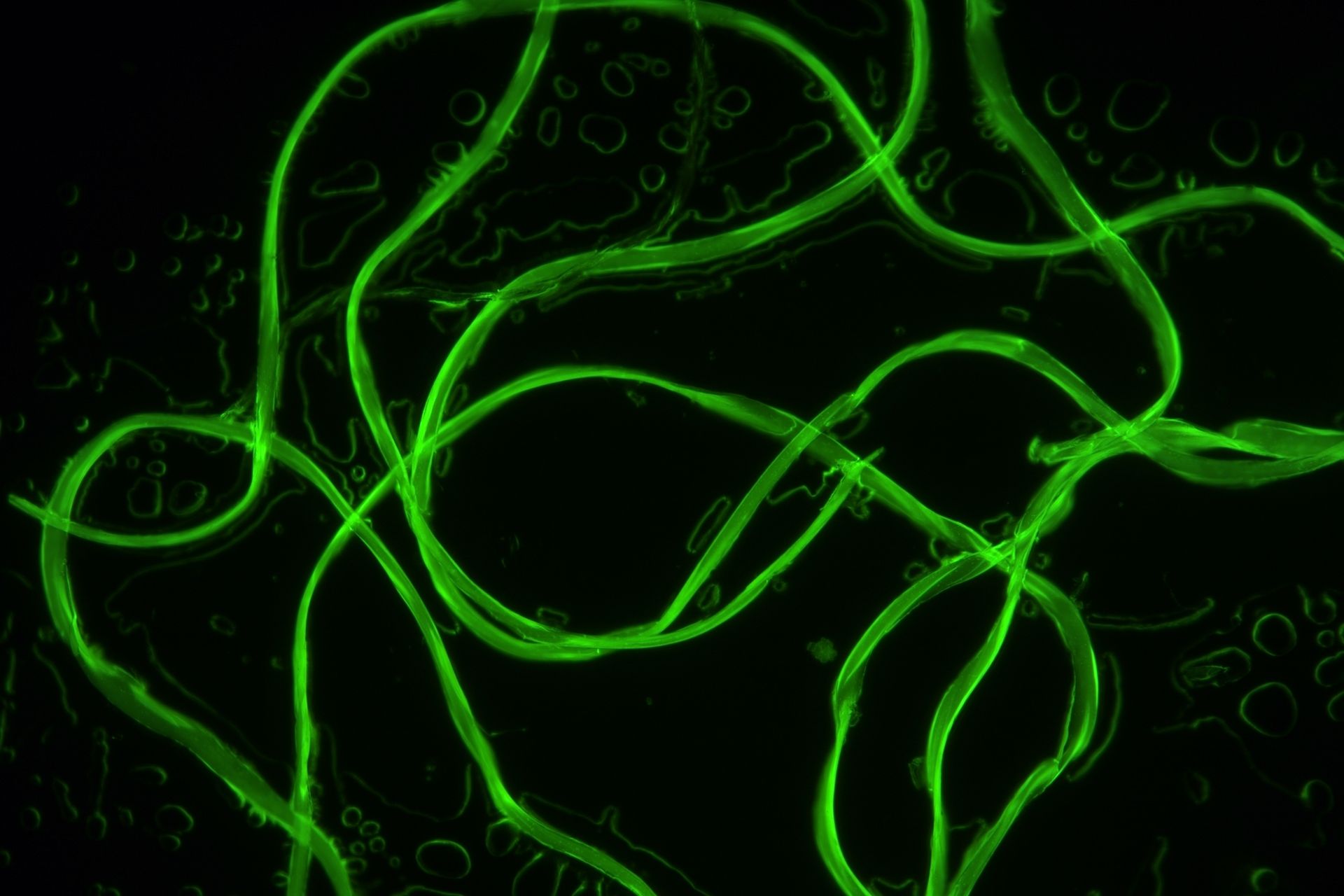
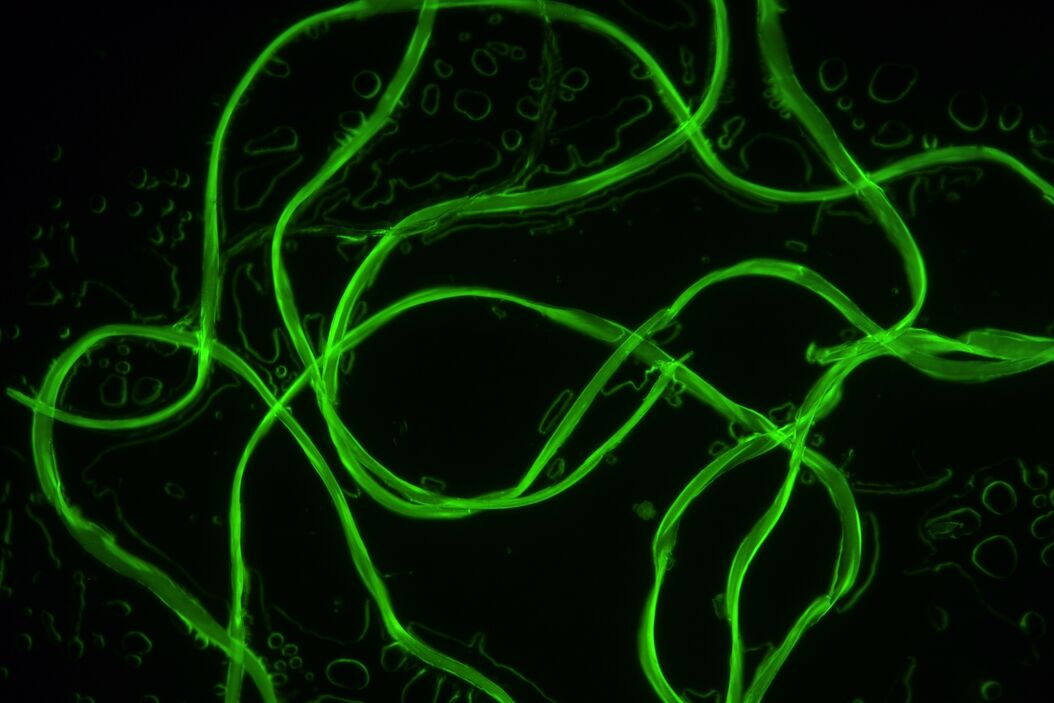
Using simple adhesive tape preparation, different fibers can be distinguished based on their fluorescence properties. This approach is useful for textile analysis, polymer identification, and microplastic detection.
Construction materials like concrete
Fluorescence can be very useful here. Concrete samples impregnated with a fluorescent resin reveal pores, air bubbles, cracks, and resin distribution. This information helps experts assess durability, freeze thaw resistance, and material quality.
Equipment and light sources
Industrial users often ask whether fluorescence microscopy requires complex or less safe light sources. It is explained in the webinar that modern systems rely mainly on light-emitting diode (LED) or metal halide light sources instead of traditional mercury lamps. LED or metal-halide sources:
- Require little to no adjustment;
- Offer long lifetimes;
- Are easy and safe to use;
- Cover visible and UV excitation wavelength ranges needed for industrial and material samples.
These advantages make fluorescence microscopy cost-effective and practical to implement into existing inspection setups.
Fluorescence and damage risk for industrial and material samples
Fluorescence microscopy uses excitation light with shorter wavelengths (and higher energy) than white light. By using suitable magnification values, reducing illumination intensity, and keeping exposure times short, sample damage due to photobleaching can be avoided. For industrial samples, photobleaching is typically far less critical than when compared to biological specimens, because dyes are used at higher concentrations. There are also practical guidelines mentioned in the webinar, so that users can balance image quality with sample protection.
Multi channel imaging improves decision making during QC and R&D
By combining brightfield, darkfield, and multiple fluorescence channels into a single image, i.e., multi channel imaging, industrial and materials scientists can clearly and quickly distinguish materials, defects, and sample structures. This approach reduces guesswork and makes interpretation easier, especially during QC, failure analysis, and R&D. For industrial engineers and scientists, fluorescence microscopy can help them make fast and reliable decisions.
What industrial and material scientists can learn
The webinar can help industrial engineers and material scientists understand:
- When fluorescence microscopy adds value for industry workflows;
- Which samples benefit most from fluorescence contrast;
- How to prepare samples quickly and safely;
- How Leica microscopes simplify fluorescence imaging ;
- How to interpret fluorescence results for inspection, QC, and R&D.
Actual, practical examples, not theoretical use cases, are discussed.
To get more information, just watch the webinar: