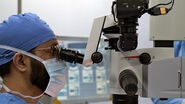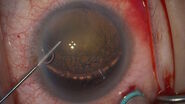


A: Standard cataract surgery
A routine phacoemulsification procedure was completed without the need for refocusing. The red reflex remained stable throughout, supporting a continuous surgical flow.
Video 1 (00:05:59:04 – 00:06:23:22): “And this is one of the main features of this microscope. The image remains clear, allowing me to transition smoothly from one step to the next without any interruptions. My initial focusing at the beginning is maintained, thanks to the remarkable capabilities of this microscope. The FusionOptics technology of Leica offers a highly detailed view of the surgical field without the need for refocusing.”
B: Multifocal IOL orientation
The orientation of a multifocal intraocular lens was guided by the visibility of concentric optical zones. The red reflex helped in confirming lens alignment.
Video 2 (00:12:03:18 - 00:12:28:13): “But after that, which is the main take home message in this case, is that in those, what we call them, concentric rings, three, multifocal lenses, orientation of the lens prior to loading is vital. And also orientation of the lens after insertion into the bag is also vital in this special type of lens.”
C: Combined phacovitrectomy in diabetic retinopathy
Cataract removal was performed prior to vitrectomy in a patient with vitreous hemorrhage. The red reflex remained visible despite posterior segment opacity.
Video 3 (00:15:20:05 - 00:16:26:23): “What I want to show to the audience here is that I'm making just a tiny bit of magnification back again, moving freely between the fragments. I hope I can move to the end of the video. Yes. This is the part where the cortical material is removed, and then we will be getting the trocar is in place to move into the back of the eye.
And, that is the take home message that after the positioning of the trocars, I'm going into the back of the eye. You might be surprised that even with that dense vitreous haemorrhage, I'm still able to have, a good red reflex and good viewing during cataract surgery.”
D: Trauma-induced cataract with zonular weakness
A case involving synechiae and capsular instability. Trypan blue was used to stain the capsule, and a capsular tension ring was inserted to stabilize the bag.
Video 4 (00:23:06:06 - 00:23:33:19): “And again, the view is unparalleled. I mean, during the surgery, thanks to the good view and, again, I try in those cases, not to enlarge, the incision. And as you can see, the CTR (Capsular Tension Ring) is going smoothly into the bag. And I'm using the second instrument with a bit of higher magnification in a while. You'll see it in a bit, as to make sure that the CTR ring plays where I intended it to be.”
Expert roundtable
Watch the expert roundtable featuring Dr. Hussein Almuhtaseb and Mr. Simon Madge where they discussed how to enhance patient outcome and safety in cataract surgery - innovations and best practices.
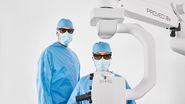
The surgeons explore how advanced visualization technologies and ergonomic surgical tools are transforming cataract surgery. They share real-world experiences and discuss how these innovations improve surgical safety, training efficiency, and surgeon wellbeing.
Discussion highlights:
- Red reflex and surgical safety
- Training benefits and team coordination
- Ergonomics and surgeon wellbeing
- The future of cataract surgery
*Disclaimer: The statements of the healthcare professionals included in this presentation reflect only their opinion and personal experience. Not all products are approved or offered in every country. Please contact your Leica representative for more information.