
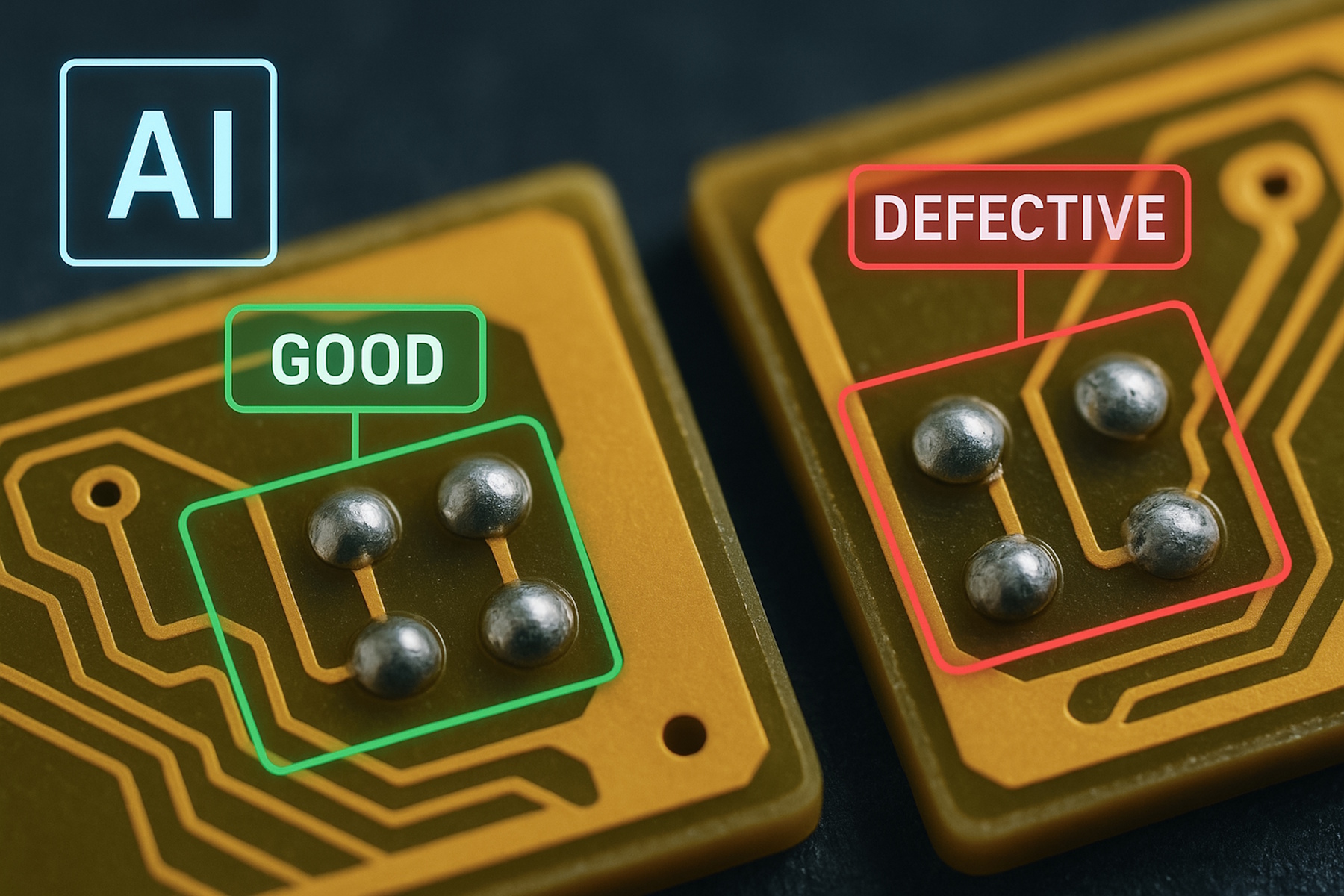
AI defect detection with edge learning
AI-based inspection systems rely on machine learning models trained with representative microscope-image data. Rather than applying fixed rules, these systems learn to recognize patterns associated with defects and features of interest. This ability allows them to adapt to variations in samples that would be difficult to capture with conventional approaches or rule-based artificial intelligence.
In many industrial workflows, inspection results are required immediately. Edge learning [1,2], which falls under machine learning, addresses this requirement by deploying trained models directly on local microscope systems. Instead of transferring data to a remote environment, analysis takes place where the image is acquired.
This approach supports real-time decision-making because it reduces latency between image acquisition and defect detection, as inspection data remains within the local and secure environment. As a result, defect detection in inspection workflows are both faster and easier to manage.
In addition, edge learning using pre-configured neural networks is easy to deploy on standard hardware (with low investment/effort needed) due to minimal labelling effort and processing time for training.
Choosing the appropriate AI image analysis for defect detection
The effectiveness of AI defect detection depends on selecting the appropriate method. Different approaches address different analytical questions and should be applied accordingly. See figure 1 below.
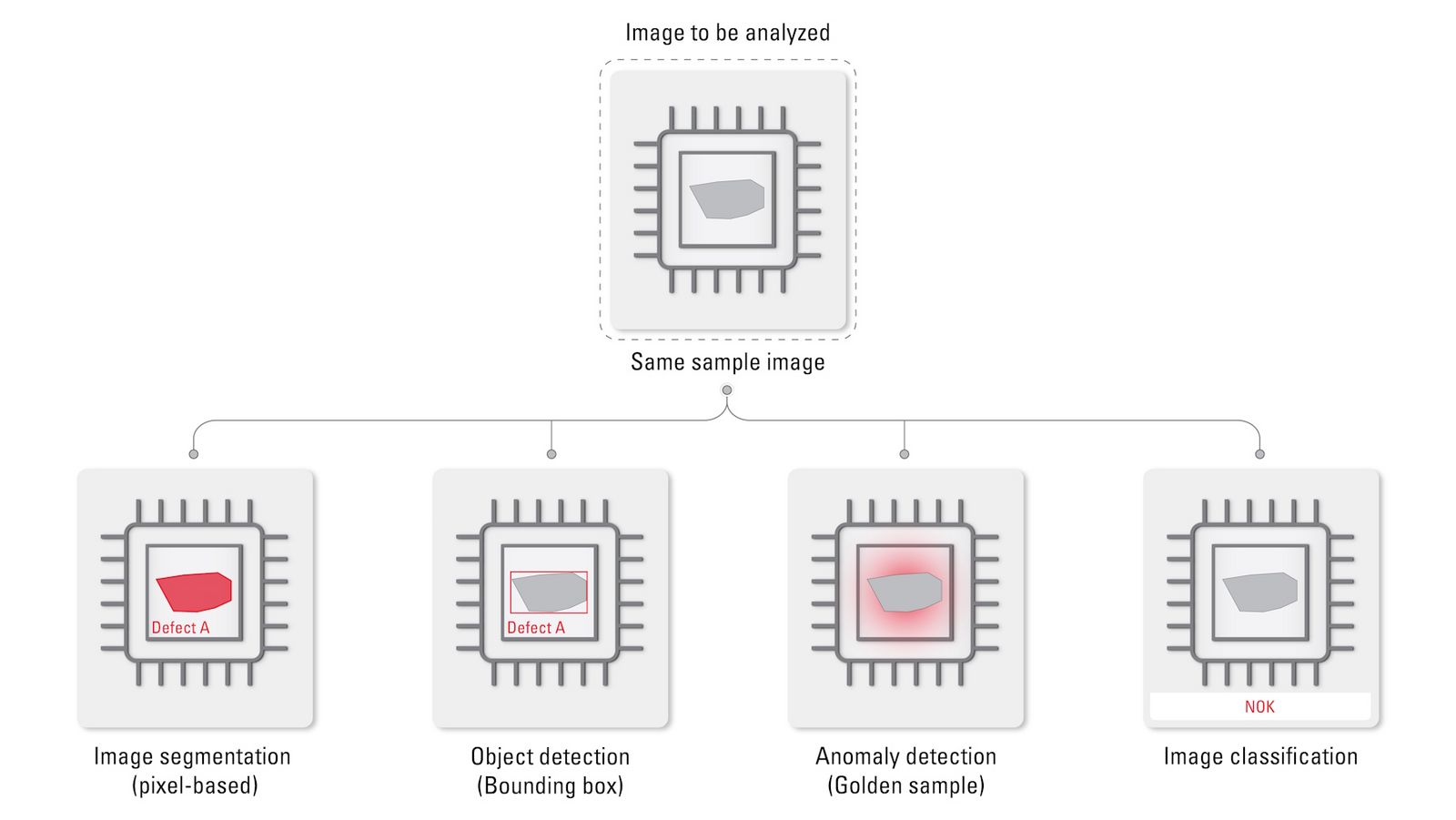
Image segmentation is used when known defects must be localized and measured in detail. Each image pixel is assigned to a class, enabling precise analysis of defect size, shape, and distribution. It is particularly relevant when quantitative measurements are required. An example of image segmentation is shown in figure 2.
Object detection is an AI technique that identifies instances of predefined objects or features in an image, assigns them to a class, and determines where each instance is located, commonly by placing a bounding box around it.
Anomaly detection is suited to situations where defect types are not fully known, helping address inspection challenges where predefined rules are not sufficient. The model learns the appearance of ‘golden samples’ and identifies deviations from that baseline. It makes it possible to detect unexpected or rare defects without extensive prior labeling.
Image classification supports rapid decision-making by assigning images to predefined categories such as acceptable or defective. It is often used in high-throughput workflows where a clear pass or fail decision is required.
These approaches form a flexible framework that can be adapted to different inspection requirements.
| Segmentation | Object detection | Anomaly detection | Image classification | |
|---|---|---|---|---|
| Type of features / defects | Known | Known | Unknown | Known |
| Primary question | Which known features are present and what is the precise size and location?
| What objects are present, and where are they approximately located? | Does the image contain something that deviates from what is considered normal or expected? | What category does this image belong to? |
| Analysis level | Individual pixels | Individual objects | Individual pixels | Entire image or field of view
|
| Typical Output | Pixel mask with boundaries and shapes of objects | Object-level label (category or class) and bounding boxes
| Heatmap highlighting suspicious regions and normal/abnormal decision or anomaly score | Image-level label, usually with confidence score
|
| Localization of features | Precise (pixel-level) | Approximate (bounding boxes) | Approximate (Heatmap) | No |
| Boundaries of features | Precise (pixel-level) | Approximate (bounding box) | No exact boundaries | No |
| Measurement of features | Yes | No | No | No |
| Typical use case | Detailed analysis | Sorting | Screening | Sorting |
Table 1: Comparison of AI techniques for feature or defect detection
Consistent defect detection
A key requirement for defect detection during quality control is consistency. AI-based inspection supports this need by applying the same criteria to every sample. Once a model is validated, it can be reused across different systems and users, minimizing operator-dependent variation.
Inspection results are stored with the image data, enabling traceability and documentation, which is particularly relevant in environments where results must be reviewed or audited. By standardizing both defect analysis and documentation, the Aivaro AI Feature Detection software module helps users achieve reproducible defect detection.
In addition to AI, an important requirement for consistency is consistent image settings (e.g. camera settings, magnification, illumination) to provide consistent images to the AI for review.
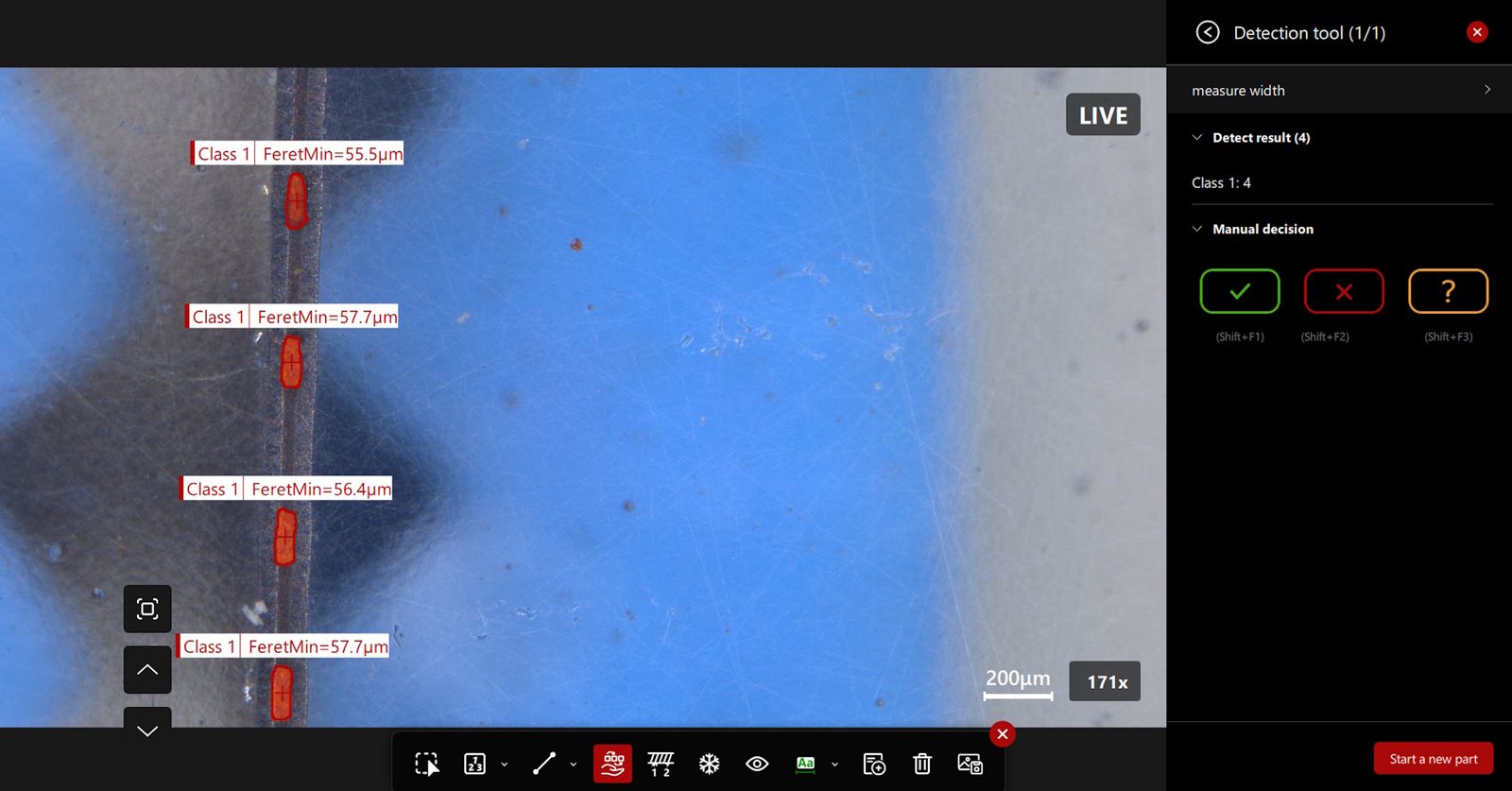
Integrating AI defect detection into workflows
For practical adoption, AI defect detection solutions must fit into existing inspection workflows. They should integrate readily into established quality control environments, without requiring major changes. For example, existing microscope solutions can still be used without changes to the SOPs, with the final decision remaining with users. The Aivaro AI Feature Detection software module can be implemented into workflows for inspection, quality control, failure analysis, and R&D, enabling users to achieve reliable defect detection.
Conclusion
By selecting an approach with edge learning, AI defect detection can be adapted to specific requirements without increasing complexity. With edge learning using pre-trained artificial neural networks enabling local, real-time processing, these systems help users make decisions efficiently while maintaining control over data and workflows. As a result, defect detection during inspection becomes reliable and efficient across different users and environments.
Solutions such as the Aivaro AI Feature Detection software module can be integrated into existing inspection workflows to support practical, scalable defect detection, enabling users to decide pass or fail rapidly and reliably.