Introduction
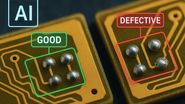
The Aivaro AI Feature Detection software module enables fast manual microscope inspection of particulate contamination on various material samples. By training different classes, reflective particles, non-reflective particles and fibers can be detected, counted, measured and documented within seconds.
Why particulate contamination matters
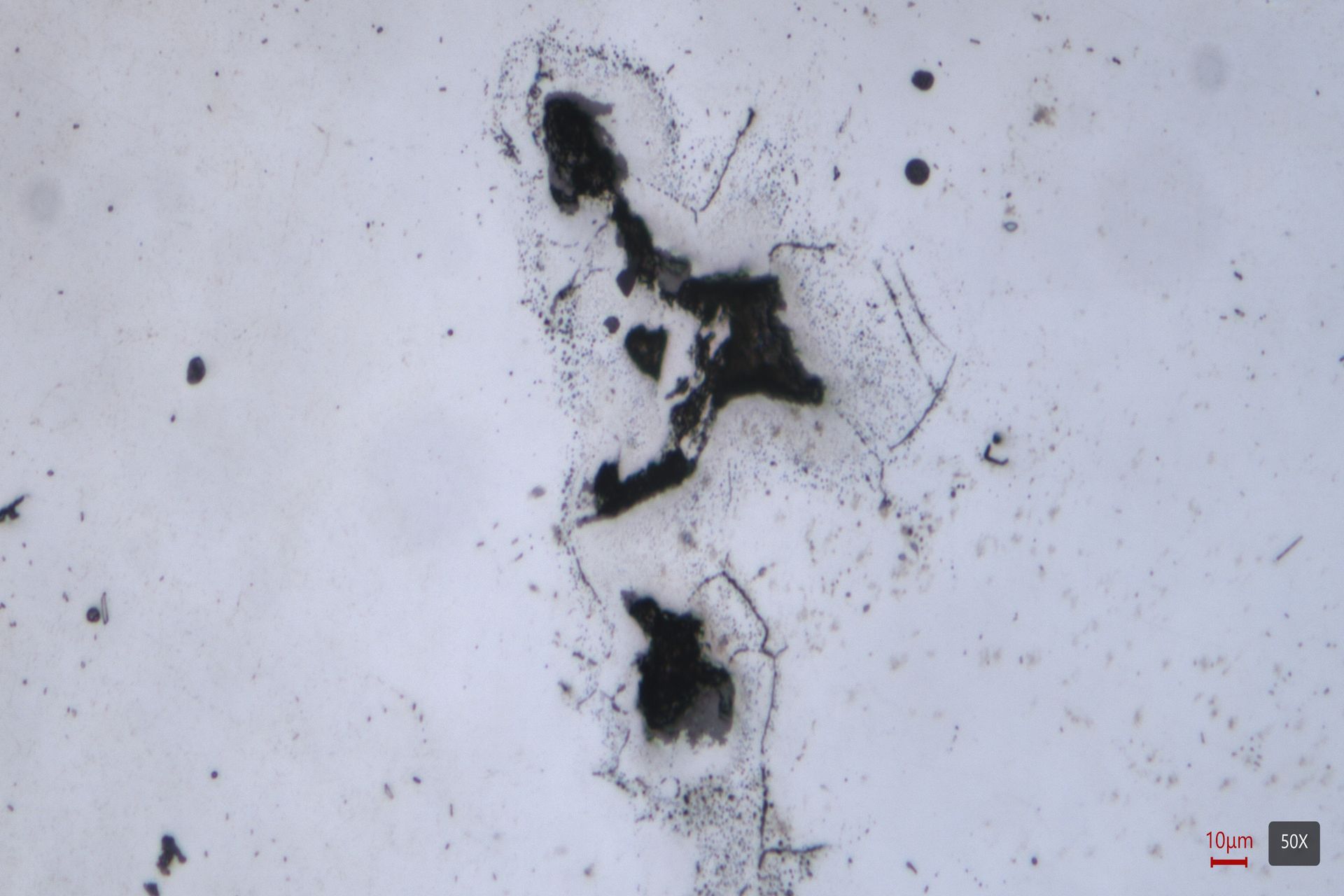
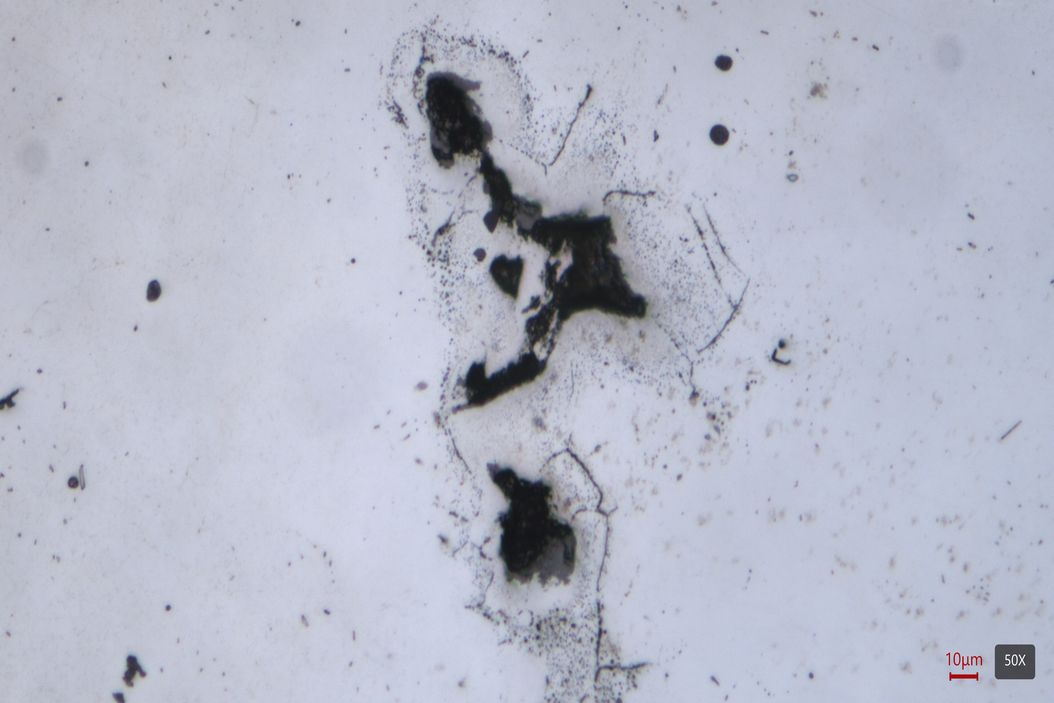
Particles, fibers and other residues can negatively affect the function, safety and lifetime of technical products. In automotive and transportation applications, hard metallic particles may cause wear, leakage, valve malfunction, bearing damage, sensor failure or electrical shorts. In electronics and microelectronics, particles may interfere with bonding, soldering, coating or electrical contacts. In battery electrode production, reliable particle counting and measurement are essential to detect metallic or oversized contaminants early and reduce the risk of short circuits, coating defects and other cell failures. In medical devices and pharmaceutical manufacturing, particulate matter can affect product safety and regulatory compliance. For this reason, technical cleanliness has become an important quality characteristic in modern manufacturing.
Technical cleanliness in manufacturing
To ensure product safety and regulatory compliance, manufacturers commonly define limits for particle size, number and type according to their specific requirements. Production teams frequently require an easy screening method to determine whether particles exceeding a critical size are present on the filter membrane. Aivaro AI Feature Detection offers a practical solution for quick manual checks, helping operators identify contamination and assess whether further investigation is necessary.
AI-based particle detection with Aivaro AI Feature Detection
It uses AI-assisted classification to distinguish different contamination categories. Users can create AI models for non-reflective particles, reflective particles and fibers. Once trained, the model automatically identifies similar objects within the image, counts occurrences and provides size-related information. Results are provided in real time, supporting rapid decision-making in quality control.

The workflow is intuitive and does not require advanced AI experience. Aivaro AI Feature Detection is based on pretrained Edge learning AI. This results in three advantages:
- Users do not need to train the model with hundreds of images to get first suitable results. Already after a small set of representative images have been labeled and trained, results are available and the system can be used.
- Users do not need to invest in computational power of used hardware. Edge learning enables processing of the analysis directly on standard hardware in your production line.
- There are no long analysis times before the results are shown. Critical features are highlighted in the live image.
Selecting the right microscope
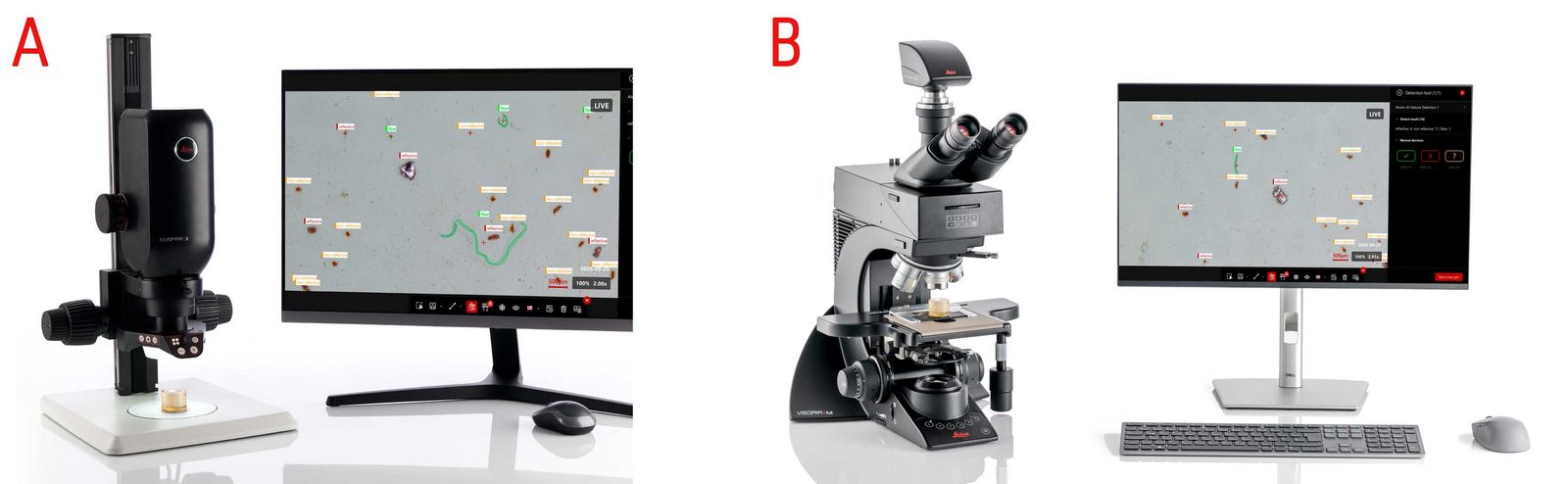
The Aivaro AI Feature Detection software module is compatible with a wide range of Leica solutions powered by the Enersight software platform. The choice of microscope depends mainly on the smallest particle size to be detected. With its small footprint, the Emspira 3 digital microscope is ideal for routine visual inspection and contamination screening of larger particles (>50µm) directly in the production line. Visoria M, a compound microscope, is recommended when smaller particles, finer fibers or higher measurement accuracy are required.
Benefits for quality control in automotive, electronics, precision engineering and medical device manufacturing
- Fast manual cleanliness screening by Aivaro AI Feature Detection allows automatic identification, measurement and classification in the live image
- Low acceptance barrier of AI-assisted identification of different particulate contaminants by easy-to-use labeling and training workflow
- Reduced operator subjectivity by AI-assisted feature detection
Conclusion
The Aivaro AI Feature Detection software module extends the Enersight ecosystem with a practical AI-based solution for particle counting and contamination assessment. By classifying reflective particles, non-reflective particles and fibers, users can perform quick and easy contamination checks. Using Emspira 3 or Visoria M, the solution covers a broad range of particle sizes and inspection requirements, supporting fast quality decisions and improved product reliability.