What is AI?
AI or artificial intelligence refers to the effort to create human-like intelligence with computer systems [1,2]. The goal is for computing machines to learn how to solve problems, make decisions on their own, and continuously improve their capabilities, much like humans do. The term “artificial intelligence” was used by scientists John McCarthy, Marvin Minsky, Nathaniel Rochester, and Claude Shannon in a title for a summer research project proposal which was published in 1955 and took place at Dartmouth University in 1956 [3-5].
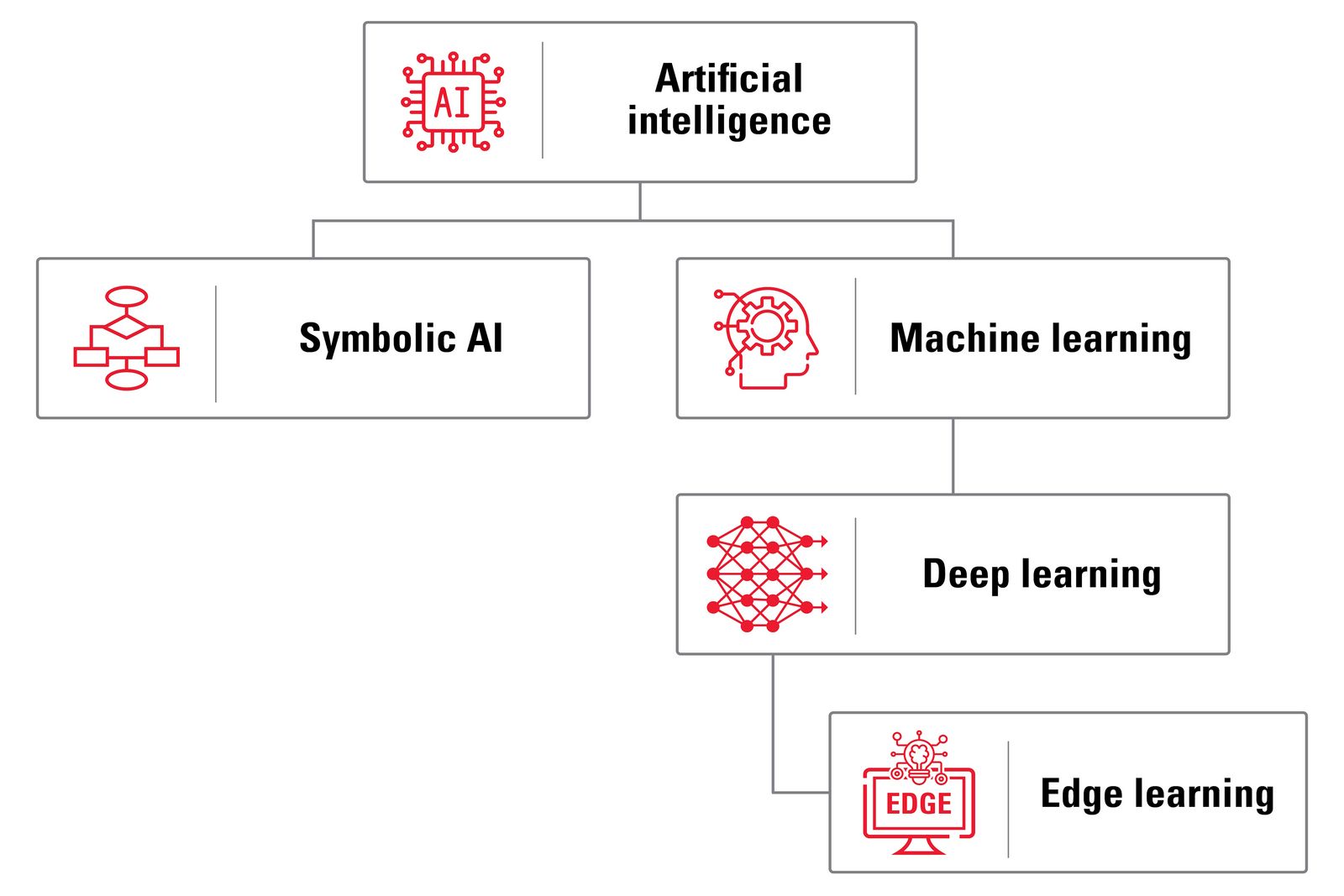
Today the term AI encompasses symbolic AI, machine learning, deep learning, and edge learning [6] (illustrated in figure 1 below).
Symbolic AI
Symbolic AI, also known as classical AI, good old-fashioned AI, or logic-based AI [7], is the term for all AI methods that are based on high-level symbolic or human-readable representations of problems. It uses logic programming, production rules, semantic nets and frames, and developed applications, e.g., symbolic mathematics, automated theorem provers, and systems based on knowledge and automated planning and scheduling.
Machine learning
Machine learning is a branch of AI where algorithms learn from existing data to recognize patterns and use them to predict future events and make decisions [8]. To develop the model, machine learning is trained using representative data and learns via “optimization” which features are relevant to the outcome. Rather than applying fixed rules, these systems learn to recognize patterns.
Deep learning
Deep learning, a subset of machine learning, uses artificial neural networks to analyze complex patterns in data, such as structures, contrast, textures, and subtle image features that may be difficult to detect using traditional image analysis methods [9]. Because deep learning can learn from large and diverse datasets, it is well suited for challenging inspection tasks with significant variation in appearance, shape, or defect characteristics. Once trained, deep learning models can deliver consistent and reproducible analysis across large numbers of samples and workflows. One of the practical challenges when deploying deep learning systems is obtaining sufficient training data. Deep learning approaches often rely on access to powerful IT infrastructure, large datasets, and extended training times.
Edge learning
In contrast to deep learning, edge learning operates with pre-trained models requiring significantly fewer images. They provide a starting point that are adapted to specific workflow tasks using a relatively small number of examples. In many cases, only data for a few examples is sufficient. This approach reduces the effort required to implement edge learning and enables faster deployment into workflows.
Overall, edge learning is designed for ease of use. Compared to deep learning, it is simple to set up and requires only a few images to be labelled, and less time for training. In addition, this can run on standard hardware and does not require high-performance and expensive hardware such as GPUs or an internet connection to the cloud. This makes it easier to deploy in existing infrastructure.
In many industrial workflows, results are required immediately to support operational decisions. Edge learning [10,11] addresses this requirement by deploying models from training directly on local systems. Instead of transferring data to a remote environment, analysis takes place where the data is acquired. This approach supports real-time decision-making by reducing latency between data acquisition and analysis, as data remains within the local environment. As a result, data security is ensured and workflows are both faster and easier to manage.
Deep learning and edge learning for industrial image analysis
For industrial applications, e.g., defect detection during microscope inspection, both the AI technologies could be applied. Please refer to table 1 below for a comparison between the two.
| Deep Learning | Edge Learning | |
|---|---|---|
| Algorithm Training | Hundreds to thousands of images | 5 to 10 images |
| Data Processing & Analysis for Learning | Hours to days | Seconds to minutes |
| Users | Significant experience and understanding of system | No prior experience |
| Deployment | With cloud/ external server or on-premise | On-premise |
Table 1: Deep learning compared to edge learning concerning image analysis for industrial applications like inspection and quality control.
Deployment architecture
Both AI technologies introduced above can be deployed on various architectures, of which the most common deployment architectures include in the cloud, on-premise, at the edge, or in hybrid architectures. Table 2 provides a short description and when this is usually used.
| Deployment Type | Description | Typical AI Technologies / When this is used |
|---|---|---|
| Cloud | AI models run on remote cloud infrastructure. Images or data are transferred to the cloud for processing and analysis. Offers virtually unlimited computing resources and scalability. | Deep learning. Particularly suitable for training and running computationally intensive AI models. |
| On-Premise | AI software and models run on servers or workstations located within the customer's facility and IT environment. Data remains within the organization. | Deep learning and edge learning, Frequently used where security, privacy, or regulatory requirements prohibit cloud usage. |
| Edge | AI processing takes place directly at or near the source of data generation, such as a microscope workstation, camera, sensor, or industrial device. | Primarily edge learning and lightweight machine learning models. Optimized for real-time decisions, low latency, and operation on standard or embedded hardware. |
| Hybrid | Combines local and cloud resources. For example, data acquisition and initial analysis may occur locally, while model training or advanced analytics are performed in the cloud. |
Table 2: A comparison of deployment types for deep and edge learning are shown above.
Conclusion
The development of computer systems with human-like intelligence is the field of AI. There are several segments of the field: Symbolic or classical AI which focuses on knowledge representation and logical reasoning; machine learning where algorithms learn to recognize patterns and predict events; deep learning which uses artificial neural networks to learn complex patterns from large amounts of data; and edge learning which takes place directly on edge devices with pre-trained models.
With edge learning enabling local, real-time processing, users maintain control over data and workflows, with easier deployment in existing infrastructure. Together, these capabilities help establish standardized industrial processes which can adapt to changing demands and help users achieve reliable results efficiently.